

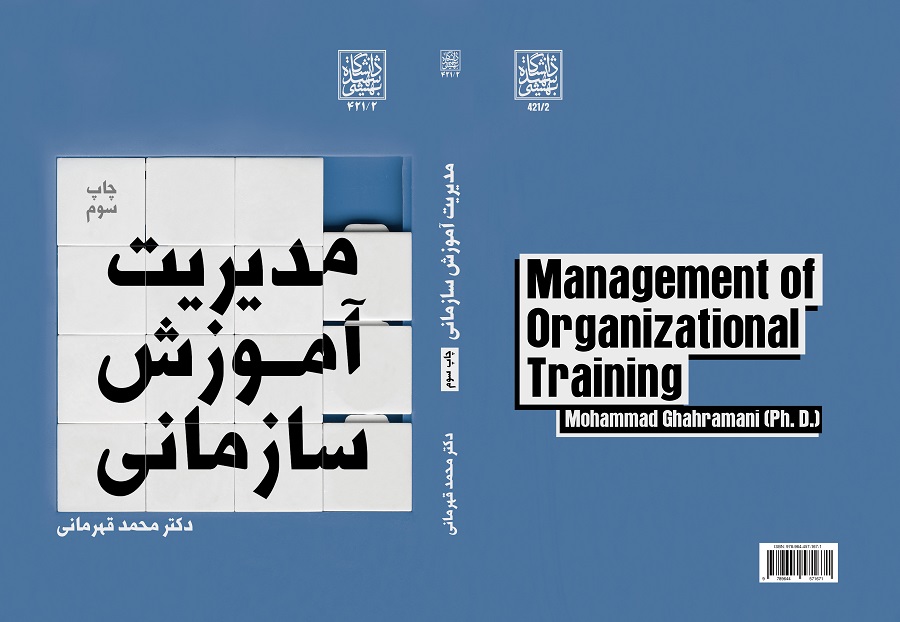
The book Management of Organizational Training, authored by Dr. Mohammad Ghahremani, Associate Professor at the Faculty of Education and Psychology of Shahid Beheshti University, has been published. This is the book’s third edition, released in 1404, in 288 pages (vaziri format), by Shahid Beheshti University Press, and offered at a price of 2,600,000 rials.
Today’s transformational trends affecting organizations are advancing with such speed and force that they have confronted managers and policy makers with changing, complex, and uncertainty-laden conditions. In this context, organizations—if they are to maintain and develop their continued existence—have no choice but to pursue continuous dynamism and actively adapt to internal and external variables. Meeting this need requires the use of tools and mechanisms, among the most effective of which are training and human resource development—more precisely, the development of an organization’s intellectual and cognitive capital. Although training is not a “cure-all” for every organizational problem or deficiency, it is among the most effective factors in preventing shortcomings and weaknesses.
From a systems perspective, organizational training can be viewed through “training management” as one of the most important subsystems, encompassing all ongoing educational and developmental efforts aimed at the growth and advancement of human resources and the empowerment of employees.
This book has been written with two main aims: first, to emphasize the importance and necessity of serious attention to training management by senior managers and organizational leaders; and second, to explain the duties, processes, techniques, and tools of organizational training management.
The content is organized into three sections:
In the first section, general concepts and introductory topics in training and improvement are presented across three chapters: “Organizational Training Management,” “Organizational Training,” and “The Learning Organization.”
The second section, which constitutes the core of the book, presents the organizational training process in six chapters (Chapters 4 through 9). Chapter 4 outlines different types of “organizational training processes” and ultimately introduces the book’s focal process, consisting of four main stages: training “planning,” “implementation,” “evaluation,” and “development.” The subsequent chapters discuss each of these four stages in detail.
The third section reflects the “visions and future outlooks of organizational training” in the coming years. Clearly, awareness of these outlooks and the evolving trends in future training and improvement can be helpful and effective in preparing organizations and companies and in creating the necessary alignment between their current training conditions and processes and these emerging perspectives and developments.
The content of this book can be useful and inspiring for managers, planners, and specialists in staff training and development, as well as instructors, researchers, and students in various fields of human resource development.
Students and interested readers can purchase the book in person from the Sales Office of the Center for Publishing Scientific Works at Shahid Beheshti University, located in the Information Technology (IT) Building, ground floor, or place an online order through the Center’s website. The electronic version is also available for purchase via the Fidibo and Taghcheh platforms